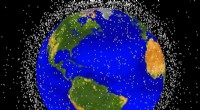
In reality, all known planets are finite in size and mass. The Earth, for example, has a finite diameter of approximately 12,742 kilometers (7,918 miles) and a finite mass of approximately 5.972 x 10^24 kilograms (1.317 x 10^25 pounds). However, when planets are considered in the context of large-scale simulations or theoretical studies, it may be convenient to assume that they are finite in order to make the calculations more manageable.
By introducing a finite planet assumption, scientists can simplify the equations of motion and reduce the computational complexity of simulating planetary systems. This can be especially useful when studying systems with a large number of planets or when investigating the long-term evolution of planetary orbits.
It's important to note that the finite planet assumption is an approximation and may not always be accurate for describing real-world planetary systems. In certain cases, the finite size and mass of planets can have significant effects on their interactions and dynamics, which may need to be taken into account for more precise modeling.