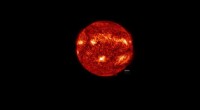
1. Sunspots: These are dark, cooler areas on the Sun's surface that appear as blotches. Sunspots are caused by strong magnetic fields that disrupt the flow of hot plasma in the Sun's atmosphere. They range in size, with some being larger than Earth. Sunspots can last for days or weeks and are often associated with solar flares and coronal mass ejections.
2. Solar Flares: Solar flares are powerful bursts of energy released from the Sun's atmosphere. They occur when stored magnetic energy in the Sun's corona is suddenly released, resulting in intense bursts of electromagnetic radiation. Solar flares can be observed in various wavelengths of light, including visible, ultraviolet, and X-rays. Large solar flares can have significant effects on Earth's communication systems, power grids, and satellite operations.
3. Prominences: Prominences are huge loops or arches of glowing gas that extend from the Sun's surface into the corona. They are composed of plasma and magnetic fields and can reach heights of tens of thousands of kilometers. Prominences are relatively stable structures but can become active and erupt, leading to coronal mass ejections.
4. Coronal Mass Ejections (CMEs): CMEs are large expulsions of plasma and magnetic fields from the Sun's corona. They occur when the Sun's magnetic field lines become unstable and reconnect, releasing vast amounts of energy. CMEs can travel through the solar system and interact with Earth's magnetic field, causing geomagnetic storms. These storms can disrupt satellite operations, power grids, and communication systems on Earth.
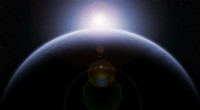
5. Solar Eclipses: Solar eclipses occur when the Moon passes between the Sun and Earth, temporarily blocking the Sun's light. During a total solar eclipse, the Moon completely covers the Sun, allowing observers to witness the Sun's outer atmosphere, known as the corona. Solar eclipses are relatively rare events and are visible only from specific locations on Earth.
6. Transits of Venus and Mercury: Transits of Venus and Mercury are rare astronomical events that occur when Venus or Mercury passes directly between the Sun and Earth. During these transits, the planet appears as a small, dark disk moving across the Sun's face. Transits of Venus occur in pairs eight years apart and are visible from Earth approximately every 105.5 years, while transits of Mercury occur more frequently, about 13 or 14 times every century.
These phenomena on the Sun's surface provide valuable insights into the Sun's activity and its impact on Earth and the rest of the solar system. Observations and studies of these events help scientists better understand solar physics, space weather, and their effects on our planet.