Star Collapse: Without gravity to hold them together, stars would no longer be able to maintain their stability. The immense pressure at the core pushing against the force of gravity would cause stars to disintegrate and collapse under their weight, resulting in massive stellar explosions. These explosions would produce tremendous amounts of energy, radiating immense heat and light across the universe.
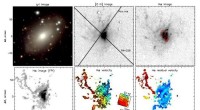
Galaxy Expansion: Without gravity to bind them together, galaxies would start to fly apart. The stars, gas, and dust that currently form the cohesive structures of galaxies would be flung into space. The galaxies would cease to exist as organized systems and transform into a dispersed dispersion of matter.
Disruption of Planetary Systems: The disappearance of gravity would mean the planets would no longer orbit their host stars. Planets would lose their bound trajectories, drift aimlessly through space, and potentially collide with other celestial bodies or be ejected from their solar systems altogether.
Black Holes: Black holes, which rely on gravity to trap and pull in nearby matter, would no longer be able to sustain their immense gravitational pull. They would lose their ability to absorb matter and energy and would eventually dissipate, dispersing their contents into the surrounding space.
Expansion of Space: In a universe without gravity, the expansion of space would accelerate uncontrollably. The fabric of space would stretch, galaxies would move further apart at a much faster pace, and the entire cosmos would become increasingly vast and dispersed.
Cosmic Chaos: The disappearance of gravity would plunge the universe into chaos. Stellar explosions, expanding space, disintegrating galaxies, and roaming planets would create an environment of turmoil, instability, and unpredictability. The cosmos would become a vast, chaotic expanse, devoid of the order and structure that gravity provides.