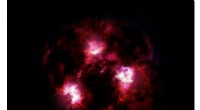
Betelgeuse is a massive star, with an estimated mass of about 10-20 solar masses. It is also very luminous, emitting about 10,000 times more light than the Sun. The star's radius is about 1,000 times larger than the Sun's, and it has a surface temperature of about 3,500 Kelvin.
Betelgeuse is a very old star, and it is currently in the late stages of its life cycle. It is thought to be about 10-12 million years old, and it is expected to explode as a supernova within the next million years or so.
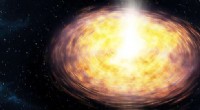
When Betelgeuse supernova, it will be a very bright event, and it will be visible from Earth even during the day. The supernova will also produce a shockwave that will travel through the interstellar medium and heat up the surrounding gas. This could lead to the formation of new stars and planets in the region.
The supernova of Betelgeuse is a significant event, and it will be of great interest to astronomers and astrophysicists. The event will provide a wealth of information about the final stages of stellar evolution, and it will help us to better understand the universe.
Here is a summary of the lifecycle of Betelgeuse:
* Betelgeuse is a red supergiant star located in the constellation Orion.
* It is one of the largest and most luminous stars in the Milky Way galaxy.
* Betelgeuse is a massive star, with an estimated mass of about 10-20 solar masses.
* It is also very luminous, emitting about 10,000 times more light than the Sun.
* The star's radius is about 1,000 times larger than the Sun's, and it has a surface temperature of about 3,500 Kelvin.
* Betelgeuse is a very old star, and it is currently in the late stages of its life cycle.
* It is thought to be about 10-12 million years old, and it is expected to explode as a supernova within the next million years or so.
* When Betelgeuse supernova, it will be a very bright event, and it will be visible from Earth even during the day.
* The supernova will also produce a shockwave that will travel through the interstellar medium and heat up the surrounding gas. This could lead to the formation of new stars and planets in the region.