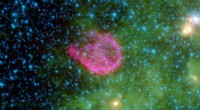
1. Supernovas: Supernovas are colossal explosions that occur when a massive star reaches the end of its lifespan. When a star exhausts its nuclear fuel, it can no longer withstand its gravity, leading to a gravitational collapse. This collapse releases a tremendous amount of energy, causing the star to explode in a supernova.
2. Core Collapse: During a supernova, the star's core undergoes a rapid and catastrophic collapse. The core compresses under its immense gravity, creating extreme temperatures and pressures. If the core's mass exceeds a certain threshold (about 3 times the mass of our Sun), it can lead to the formation of a black hole.
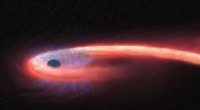
3. Black Hole Formation: In the aftermath of a supernova, the collapsed core may form a black hole. If the core's density and gravitational pull are strong enough, it can overcome all outward forces and create a region known as a singularity. This singularity is a point of infinite density and gravity, defining the center of a black hole.
4. Types of Black Holes: Supernovas can give rise to different types of black holes:
- Stellar Black Holes: These black holes are formed from the remnants of massive stars that have undergone a supernova. They range in mass from a few to tens of solar masses.
- Supermassive Black Holes: Supermassive black holes reside at the centers of most galaxies, including our Milky Way. They are much more massive than stellar black holes, with masses millions or even billions of times that of our Sun. The origin of supermassive black holes is still not fully understood, but it's believed that they may be the result of mergers of smaller black holes or the accumulation of mass over cosmic time.
5. Fate of Supernova Cores: Not all supernovae lead to black hole formation. If the core's mass is below the critical threshold, it can form a neutron star, which is an extremely dense object composed primarily of neutrons.
In summary, supernovas are the cataclysmic events that can lead to the creation of black holes, particularly stellar black holes. The massive cores of stars, upon collapsing during supernovae, can form singularities and become black holes if their density and gravitational pull exceed certain limits. Supernovas are crucial for shaping the universe's evolution and the formation of these fascinating and mysterious objects that play a significant role in shaping the cosmos.