Here's a general overview of how new stars are born:
1. Formation of Molecular Clouds: In galaxies, there are vast clouds of gas and dust called molecular clouds. These clouds are composed primarily of hydrogen and helium, along with trace amounts of other elements.
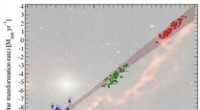
2. Gravitational Collapse: Within a molecular cloud, gravitational forces cause the cloud to start contracting under its own gravity. As the cloud collapses, it fragments into smaller, denser clumps. These clumps are called protostars.
3. Protostar Formation: As a protostar continues to contract, its core becomes denser and hotter. The increasing temperature and density lead to the formation of a nuclear fusion reaction, which marks the birth of a new star.
4. Main Sequence Phase: Once the protostar has ignited nuclear fusion, it enters what is known as the main sequence phase. During this phase, the star burns hydrogen fuel in its core, releasing energy and light. The star remains in the main sequence phase for a significant portion of its lifetime.
5. Further Evolution: After the star exhausts its hydrogen fuel, it evolves through various subsequent stages, which can include becoming a red giant, supergiant, or even exploding as a supernova. The exact evolutionary path of a star depends on its initial mass.
So, as long as there are regions with sufficient gas and dust in the universe, star formation will continue to occur and new stars will continue to be born. The process of star formation is essential for maintaining the balance and evolution of galaxies and the universe as a whole.