The primary process occurring within the sun is nuclear fusion. Here's a closer look at what's present in the sun:
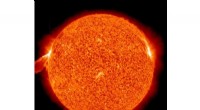
Plasma: The sun is composed of a hot, luminous plasma. Plasma is a state of matter where the electrons are separated from the atomic nuclei, creating a positively charged gas of ions and freely moving electrons.
Hydrogen and Helium: The sun's composition primarily consists of hydrogen (around 92%) and helium (around 8%).
Core Temperature and Pressure: The sun's core, where the nuclear reactions take place, reaches extremely high temperatures of about 27 million degrees Fahrenheit (15 million degrees Celsius). The immense pressure in the sun's core forces hydrogen atoms to overcome their natural repulsion and fuse together.
Nuclear Fusion process: In the sun's core, hydrogen nuclei (protons) combine in a series of nuclear fusion reactions, releasing vast amounts of energy in the form of gamma rays and neutrinos.
Proton-Proton Chain Reaction: The primary fusion process in the sun is called the proton-proton chain reaction. It starts when two protons fuse to form a deuteron (a heavy hydrogen isotope), which then combines with another proton to create a helium-3 nucleus. This nucleus further fuses with another helium-3 nucleus to form helium-4 (a stable isotope of helium). This process releases energy and neutrinos.
Carbon-Nitrogen-Oxygen Cycle (CNO Cycle): Another fusion process, the CNO cycle, contributes about 1% to the sun's energy production. It involves carbon, nitrogen, and oxygen nuclei as catalysts, facilitating the fusion of protons to form helium.
Solar Radiation: The energy generated through nuclear fusion in the sun's core eventually travels outward and ultimately reaches the sun's surface. The sun's surface emits an immense amount of electromagnetic radiation, including visible light, ultraviolet (UV) rays, and infrared (IR) radiation, which constitute solar radiation.
In summary, the sun primarily contains plasma composed of hydrogen and helium, with nuclear fusion reactions occurring in its core. Hydrogen nuclei fuse to form helium, releasing energy in the form of gamma rays and neutrinos, which are then radiated as solar energy into the surrounding space.