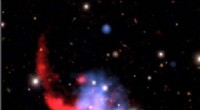
Light-years are used for measuring vast distances in space, such as the distances between stars, galaxies, and other celestial objects. For example, the closest star to our solar system, Proxima Centauri, is about 4.2 light-years away. The center of our Milky Way galaxy is about 27,000 light-years away, and the Andromeda Galaxy, one of our nearest neighboring galaxies, is about 2.5 million light-years away.
When measuring even greater distances, astronomers may also use units such as parsecs or megaparsecs. A parsec is defined as the distance at which an object has a parallax angle of one arcsecond (1/3600 of a degree) when viewed from opposite ends of the Earth's orbit around the Sun. One parsec is approximately 206,265 astronomical units (AU) or about 3.26 light-years. A megaparsec (Mpc) is one million parsecs.
These units allow astronomers to measure and comprehend the immense distances across the vast expanse of the cosmos.