* Jupiter: The largest planet in our solar system, with a diameter of approximately 142,984 kilometers (88,846 miles).
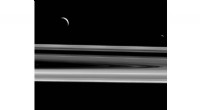
* Saturn: The second-largest planet in our solar system, known for its prominent rings, with a diameter of about 120,536 kilometers (74,897 miles).
* Uranus: The third-largest planet in our solar system, with a diameter of roughly 51,118 kilometers (31,763 miles).
* Neptune: The fourth-largest planet in our solar system, with a diameter of approximately 49,528 kilometers (30,774 miles).
Beyond our solar system, astronomers have discovered numerous extrasolar planets, some of which are even larger than Jupiter. These massive exoplanets often belong to the class of "super Jupiters" or "gas giants." Here are a few notable examples:
* Kepler-452b: Discovered in 2015, this exoplanet orbits a sun-like star called Kepler-452, located about 1,400 light-years from Earth. It has a radius about 1.6 times that of Jupiter and a mass approximately 4 times greater.
* HD 100546 b: This exoplanet orbits the star HD 100546, located approximately 337 light-years from Earth. It has a radius about 1.7 times that of Jupiter and a mass roughly 13 times greater.
* WASP-17b: Discovered in 2009, WASP-17b is located about 1,000 light-years from Earth and orbits a star named WASP-17. This massive exoplanet has a radius about 1.5 times that of Jupiter and a density similar to polystyrene, making it one of the least dense planets known.
* KELT-9b: Discovered in 2017, KELT-9b orbits the star KELT-9, located approximately 650 light-years from Earth. It has a radius about 1.8 times that of Jupiter and a mass approximately 2.9 times greater. KELT-9b is known for its extremely high surface temperature, reaching several thousand degrees Celsius.
It's important to note that the scientific understanding of planets and their characteristics is constantly evolving, and new discoveries are being made regularly. As astronomers explore more distant regions of the universe and refine their observational techniques, they may come across even larger and more massive planets in the future.