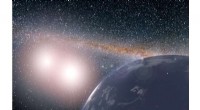
When light from a star passes through the Earth's atmosphere, it encounters layers of air with varying densities and temperatures. These variations cause the light to bend and change direction slightly. As a result, the star's light appears to shimmer or fluctuate, giving it a twinkling effect.
The amount of twinkling varies depending on several factors, including the star's position in the sky, atmospheric conditions, and the observer's location. Stars near the horizon tend to twinkle more than those higher in the sky because the light from lower-altitude stars passes through more layers of the atmosphere.
Planets, on the other hand, generally do not exhibit the same level of twinkling as stars. This is because planets are much closer to Earth and appear as larger disks rather than point-like sources. The larger apparent size of planets means the light from different parts of the planet averages out the effects of atmospheric turbulence, reducing the visibility of twinkling.
So, the next time you look up at a clear night sky, enjoy the beautiful sight of stars twinkling above you. It's a reminder of the dynamic nature of our atmosphere and the vast distances separating us from these celestial bodies.