1. Size: Stars are individual celestial bodies, while galaxies are vast systems containing billions to trillions of stars. Stars range in size from tiny red dwarfs to massive blue giants, but they are generally much smaller compared to galaxies. Galaxies, on the other hand, are much larger entities that can span hundreds of thousands to millions of light-years in diameter.
2. Composition: Stars are primarily composed of hot, glowing gases, mainly hydrogen and helium, which undergo nuclear fusion in their cores to produce energy. Galaxies, on the other hand, contain stars, as well as interstellar gas, dust, dark matter, and possibly black holes at their centers.
3. Structure: Stars have a well-defined spherical or oblate spheroidal shape due to their gravitational forces. Galaxies, however, exhibit various shapes and structures, including spiral galaxies, elliptical galaxies, and irregular galaxies. Each galaxy has a distinct morphology and distribution of stars, gas, and dark matter.
4. Energy Output: Stars emit their own light and energy through nuclear fusion reactions. The energy output of a star depends on its mass and temperature. Galaxies, on the other hand, emit light from the combined radiation of their constituent stars, gas, and dust. The overall luminosity of a galaxy is influenced by the number of stars it contains and their individual brightnesses.
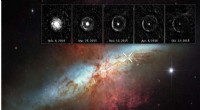
5. Location: Stars can be found within galaxies. Galaxies are the largest gravitationally bound systems in the universe and contain stars, star clusters, nebulae, and other celestial objects. Stars are distributed within galaxies in different patterns and concentrations, such as spiral arms or central bulges.
6. Age: Stars have finite lifespans determined by their masses. Massive stars have shorter lives, while smaller stars can exist for billions of years. Galaxies, on the other hand, are much older and can exist for billions to tens of billions of years.
7. Number and Distribution: There are billions of stars within a single galaxy, and there are billions of galaxies in the observable universe. Galaxies are not evenly distributed but are often found in clusters and superclusters, forming large-scale structures in the cosmos.
In summary, stars are individual celestial bodies that produce their own energy through nuclear fusion, while galaxies are vast systems of stars, gas, dust, and dark matter that come in various shapes and sizes. Stars exist within galaxies, and galaxies are the largest organized structures in the universe. Understanding the differences between stars and galaxies helps us comprehend the diverse scales and complexities of the cosmos.