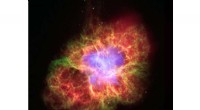
As the protostar continues to collapse under its own gravity, it heats up and becomes more luminous. When the temperature reaches about 4 million degrees Celsius, the protostar begins to shine by its own light and becomes a "main sequence" star. This marks the end of the protostar phase and the beginning of the star's "main sequence" phase, which is the most stable and longest-lasting phase in its life.
Protostars are typically found in giant molecular clouds (GMCs), which are vast complexes of cold, dense gas and dust where new stars are constantly forming. The gas and dust in GMCs is compressed and heated by the gravitational forces within the cloud, leading to the formation of individual protostars.
Protostars can have different masses and sizes, and they can be classified into different types based on their properties and evolutionary stage. Some common types of protostars include:
1. Class 0 Protostars: These are the earliest and coldest protostars, with temperatures below 20 Kelvin (-253.15 degrees Celsius) and no evidence of outflows or jets.
2. Class I Protostars: These protostars have temperatures of around 20 to 50 Kelvin and show evidence of outflows or jets of material ejected from the protostar.
3. Class II Protostars: These protostars have temperatures above 50 Kelvin and are surrounded by a large envelope of gas and dust. They show strong evidence of outflows and jets.
4. Class III Protostars: Also known as "T Tauri" stars, these protostars have temperatures similar to Class II protostars but are in a more advanced evolutionary stage. They are still surrounded by a circumstellar disk of gas and dust, but the disk is smaller and less massive than in earlier stages.
The study of protostars is an important area of astrophysics as it helps us understand the early stages of star formation and the processes that lead to the birth of new stars.