For a non-rotating black hole (known as a Schwarzschild black hole), the temperature is inversely proportional to its mass. This means that more massive black holes have lower temperatures. The formula for the temperature of a Schwarzschild black hole is given by:
Temperature (T) = (h * c^3) / (8 * pi * G * M * k)
Where:
h is the Planck constant
c is the speed of light
G is the gravitational constant
M is the mass of the black hole
k is the Boltzmann constant
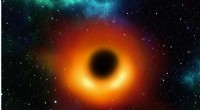
According to this formula, the temperature of a black hole decreases as its mass increases. Supermassive black holes, which can have masses billions or even trillions of times that of the Sun, have extremely low temperatures, close to absolute zero (-273.15 degrees Celsius).
In contrast, smaller black holes, such as stellar black holes formed from the collapse of massive stars, can have much higher temperatures. These black holes can emit X-rays and gamma rays, making them detectable by telescopes.
Additionally, the concept of temperature in black hole physics is often associated with the event horizon, which is the boundary beyond which nothing, not even light, can escape. The temperature of the event horizon is known as the Hawking temperature and is related to quantum effects near the black hole.
Therefore, while black holes are indeed cold compared to many celestial bodies, the temperature of a black hole depends on its mass and other factors, and it is not a simple comparison across all black holes in the universe.