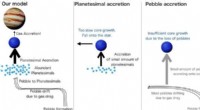
Over time, the star will gather more and more mass from the surrounding nebula. This process is called accretion. As the star grows in mass, it will also increase in temperature and luminosity. Eventually, the star will become so hot that it will begin to fuse hydrogen atoms into helium atoms. This process is called nuclear fusion. Nuclear fusion is what powers stars and provides them with their light and heat.
The nebula surrounding a star can also give birth to other objects, such as planets, moons, and comets. These objects form when leftover material from the star's formation clumps together and begins to orbit the star.
Nebulae are an essential part of the universe. They are the birthplace of stars and stellar systems, and they provide the raw materials for the formation of planets, moons, and comets. Without nebulae, the universe would be a much different place.