Now, if the mass of the neutron star exceeds a certain critical value, known as the Chandrasekhar mass, which is approximately 1.4 solar masses, the gravitational force overcomes the neutron degeneracy pressure. This leads to a further collapse of the neutron star. The exact details of what happens next are still a subject of active research and depend on various factors, such as the rotation of the star and the presence of a strong magnetic field. However, several scenarios are proposed:
1. Formation of a Black Hole: If the collapsed neutron star exceeds the critical mass for a black hole, it collapses further under its own gravity and forms a black hole. In this case, the gravitational pull is so strong that nothing, not even light, can escape from the region. The event horizon, the boundary beyond which escape is impossible, surrounds the black hole.
2. Quark-Gluon Plasma: In certain cases, instead of forming a black hole, the neutron star may undergo a phase transition where the neutrons break down into their constituent quarks and gluons. This results in the formation of a quark-gluon plasma, which is a state of matter that existed in the early universe shortly after the Big Bang.
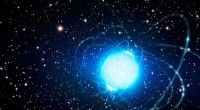
3. Magnetar Formation: If the collapsing neutron star has a strong magnetic field, it can generate incredibly powerful magnetic fields known as magnetars. Magnetars emit electromagnetic radiation, including X-rays and gamma rays, and they can exhibit sudden bursts of energy called magnetar flares.
These are some possible outcomes when a dying neutron star collapses under its gravity, but the exact behavior depends on the specific conditions and remains an active area of astrophysical research.