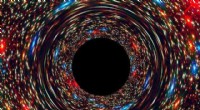
Gravitational waves are ripples in spacetime that propagate at the speed of light, caused by the acceleration of massive objects. When two black holes spiral toward each other and eventually merge, they create strong gravitational waves. These waves carry information about the properties of the black holes and their interaction, and can be detected by sensitive instruments like the Laser Interferometer Gravitational-Wave Observatory (LIGO).
When gravitational waves are detected, scientists analyze the data to extract information about the black hole merger event. They can determine the masses and spins of the black holes, the distance to the event, and the time it occurred. This information provides insights into the nature of black holes and the dynamics of their interactions, allowing astronomers to test theories and models of black hole formation and evolution.
The term "sound" is used to describe gravitational waves in a simplified and accessible manner. Gravitational waves are not audible to the human ear, as they are not pressure waves like sound waves. They exist as distortions in spacetime, and require specialized instruments to detect.
Overall, the significance of detecting sound produced by two black holes colliding lies in its scientific importance for studying the properties of black holes, testing fundamental physics theories, and expanding our understanding of the universe.