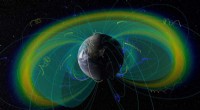
The Earth's gravity is strongest at the poles and weakest at the equator. This is because the Earth is not perfectly spherical. It is slightly flattened at the poles and bulges at the equator. This means that objects are closer to the Earth's center at the poles than they are at the equator. The closer an object is to the Earth's center, the greater the gravitational pull it experiences.
For example, someone stands at sea level at the equator weighs less than someone standing at sea level at the poles because someone at the equator is farther away from the Earth's center.
The difference in gravity between the poles and the equator is small. At sea level, the gravitational acceleration is approximately 9.8 m/s^2 at the poles and 9.78 m/s^2 at the equator. This difference is not noticeable to most people.