Several reasons contribute to this distribution:
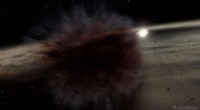
Collisional Fragmentation: Asteroids frequently collide with each other. When the impact energy is sufficient, an asteroid may break into smaller fragments. Over time, this process generates smaller asteroids from the breakup of larger ones.
Orbital Perturbations: The gravitational influence of planets, particularly Jupiter, perturbs the orbits of asteroids. These perturbations can cause some asteroids to collide with each other or send them into unstable trajectories, leading to their destruction or ejection from the asteroid belt.
Accretion and Growth: Asteroids can also grow in size through accretion, accumulating mass from the surrounding debris in the asteroid belt. However, the process of collisional fragmentation acts as a counterbalance to significant growth, preventing the formation of numerous very large asteroids.
Additionally, the largest asteroids may have formed through different mechanisms, such as the early accumulation of planetesimals during the formation of the Solar System. They may have survived intact to the present day, while the smaller asteroids are the remnants of larger objects that have been fragmented over time.
Therefore, the interplay between collisional fragmentation, orbital perturbations, accretion, and early formation processes results in the observed distribution of asteroid sizes.