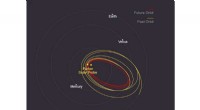
The horizon is not a fixed line, but rather changes depending on the observer's location and the time of day. As the Earth rotates on its axis, the horizon appears to move, and different parts of the sky become visible. At sunrise, the horizon is in the east, and at sunset, it is in the west.
The horizon is also affected by the curvature of the Earth. As the Earth is a sphere, the horizon appears to be curved, and objects near the horizon appear to be lower than objects that are higher in the sky. This is why ships appear to sink below the horizon as they sail away from land.
The horizon is an important reference point for navigation and astronomy. By measuring the angle between the horizon and a celestial object, navigators can determine their location on Earth. Astronomers use the horizon to track the movement of stars and planets across the sky.
Here is a more detailed explanation of how the horizon is formed:
* The Earth's surface is a sphere. This means that it is curved, and the horizon is the line that divides the Earth's surface from the sky.
* The celestial sphere is an imaginary sphere that surrounds the Earth. It is centered at the Earth's center, and its radius is infinite.
* The horizon is the intersection of the plane of the Earth's surface with the celestial sphere. It is a circle that divides the celestial sphere into two halves: the visible half and the invisible half.
* The visible half of the celestial sphere is the part that is above the horizon. It contains all of the stars, planets, and other objects that we can see from Earth.
* The invisible half of the celestial sphere is the part that is below the horizon. It contains all of the stars, planets, and other objects that we cannot see from Earth.
The horizon is a dynamic line that is constantly changing. As the Earth rotates on its axis, the horizon appears to move, and different parts of the sky become visible. At sunrise, the horizon is in the east, and at sunset, it is in the west.
The horizon is also affected by the curvature of the Earth. As the Earth is a sphere, the horizon appears to be curved, and objects near the horizon appear to be lower than objects that are higher in the sky. This is why ships appear to sink below the horizon as they sail away from land.
The horizon is an important reference point for navigation and astronomy. By measuring the angle between the horizon and a celestial object, navigators can determine their location on Earth. Astronomers use the horizon to track the movement of stars and planets across the sky.