1. Prediction through periodic trends: By studying the properties and patterns of known elements, scientists can predict the existence and properties of missing elements. This is done by analyzing periodic trends, such as atomic number, atomic radius, ionization energy, and electronegativity.
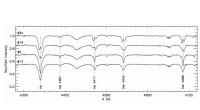
2. Spectroscopic analysis: Spectroscopic techniques, such as atomic emission spectroscopy and absorption spectroscopy, can provide information about the elemental composition of substances. By analyzing the characteristic wavelengths of light emitted or absorbed by atoms, scientists can identify the presence of specific elements, including those that may be new or missing.
3. Nuclear reactions: Bombarding a target material with high-energy particles, such as protons or neutrons, can create new elements through nuclear reactions. By carefully controlling and monitoring these reactions, scientists can synthesize new elements that do not naturally occur on Earth.
4. Particle accelerators: Particle accelerators, such as the Large Hadron Collider (LHC) at CERN, can reach extremely high energies and create conditions for the formation of new particles and elements. These facilities allow scientists to study the fundamental properties of matter and potentially discover new elements that exist only for a fraction of a second.
5. Radioactivity and decay studies: Some missing elements can be found as decay products of radioactive elements. By studying the radioactive decay chains of known elements, scientists can identify and characterize new elements that are produced during these processes.
6. Theoretical calculations: Quantum mechanics and computational chemistry can be used to predict the properties and behavior of unknown elements. Theoretical models and simulations can provide insights into the electronic structure, stability, and reactivity of potential new elements.
7. Planetary science and meteorite analysis: Studying primitive meteorites and materials from other planets can provide clues about the existence of rare or exotic elements. The analysis of extraterrestrial samples can reveal the presence of elements that are not easily found on Earth.
By combining these techniques and leveraging advancements in technology and scientific understanding, scientists continue to fill the gaps in the periodic table and expand our knowledge of the elements that make up the universe.