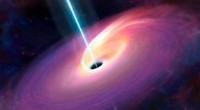
Tidal disruption events (TDEs) occur when a star passes too close to a supermassive black hole and is torn apart by the black hole's gravitational forces. The resulting debris forms a hot, bright accretion disk around the black hole, which can be observed by telescopes.
TDEs are relatively rare events, but they can provide valuable insights into the nature of black holes and their surroundings. By studying TDEs, astronomers can learn about the mass and spin of black holes, as well as the structure of the gas and dust surrounding them.
What TDEs Can Reveal About Black Holes
* Mass: The mass of a black hole can be estimated by measuring the velocity of the gas and dust in the accretion disk. The more massive the black hole, the faster the gas and dust will be moving.
* Spin: The spin of a black hole can be estimated by measuring the shape of the accretion disk. A rapidly spinning black hole will produce a thin, circular accretion disk, while a slowly spinning black hole will produce a thick, elliptical accretion disk.
* Structure of the surrounding gas and dust: TDEs can also provide insights into the structure of the gas and dust surrounding black holes. By observing the emission from the accretion disk, astronomers can learn about the density and temperature of the gas and dust, as well as the presence of any dust grains.
TDEs and the Future of Black Hole Research
TDEs are a valuable tool for studying black holes and their surroundings. By continuing to observe TDEs, astronomers will be able to learn more about the nature of these fascinating objects and their role in the universe.
Additional Information
* The first TDE was discovered in 1999 by astronomers using the Hubble Space Telescope.
* TDEs are thought to occur about once per 100,000 years in a galaxy the size of the Milky Way.
* The closest TDE to Earth occurred in 2005, when a star was torn apart by the supermassive black hole at the center of the Andromeda Galaxy.
* TDEs are a key source of information about the growth of black holes over time.