Simulations led by researchers at the University of California, Santa Cruz, and the University of California, Berkeley, found that such collisions can have a significant impact on the hot gas and dusty material that surround supermassive black holes, altering the conditions in the regions where new stars are born. The results of the research team’s simulations are set to be published in The Astrophysics Journal.
“We are particularly interested in what happens to the gas when a star interacts with a supermassive black hole,” said Ryan Pfeifle, a Ph.D. candidate at UC Santa Cruz and the first author of the paper. “If enough gas can be put onto a specific trajectory, it can fall directly onto the black hole, leading to rapid growth and the formation of ‘active galactic nuclei,’ where copious amounts of radiation and jets of plasma are ejected from the surroundings of the black hole. Understanding the details of this process is one of the main goals of this work.”
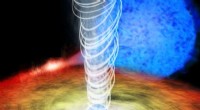
Supermassive black holes are present at the centers of almost all galaxies, and those that are actively accreting gas from their surroundings are known as active galactic nuclei, among the brightest and most energetic objects in the universe. One way to grow these black holes is through collisions with stars, which can be pulled in by the immense gravitational pull and stretched apart by tidal forces.
The researchers’ simulations reveal the detailed pathways by which gas in the centers of galaxies loses energy, cools down, and falls toward the black hole. This gas may originate from stars that the black hole has disrupted or from the galaxy itself. The simulations show that the material forms streams that flow along specific paths, called “loss cones,” which lead directly toward the black hole.
“Gas that has enough energy to overcome this potential energy barrier can end up in orbits that become more and more eccentric—similar to comets around the Sun,” said coauthor Enrico Ramirez-Ruiz, a professor of astronomy and astrophysics at UC Santa Cruz. “These highly elliptical orbits bring the gas close enough to the black hole to fall in.”
The simulations also show that the gas stream toward the black hole can become turbulent, like a river with many whirlpools and disturbances, which can heat the gas and reduce the amount of material available for accretion onto the black hole. This feedback might regulate the growth of black holes and the luminosity of active galactic nuclei.
The researchers plan to perform additional simulations to explore how the properties of supermassive black holes and their surroundings affect the efficiency of accretion and the dynamics of gas streams. This work could help astronomers understand why some galaxies have more active central black holes than others and why the growth of black holes is linked to galaxy evolution.