Using quasars, extremely bright objects powered by supermassive black holes, as cosmic signposts, the group precisely measured how fast the universe was expanding 13 billion years ago. They found that at this early epoch the universe was about five times slower than it is today. This is the most detailed look yet at the universe when it was only about 890 million years old.
The expansion rate, or Hubble constant, is a key ingredient to measuring the age and evolution of the universe. By making precise measurements of the Hubble constant at different points in time, astronomers can learn how the expansion rate has changed over time and constrain the properties of the universe, including the amount of normal matter, dark matter and dark energy.
The new result confirms models based on the prevailing cosmological theory of the universe, known as the Lambda cold dark matter model, which posits that about 70 percent of the universe is dark energy and 25 percent dark matter with only about five percent composed of normal matter.
The team was led by Ohio State University Professor of Astronomy and Astrophysics Patrick Petitjean, along with former Ohio State postdoctoral fellow and current Enrico Fermi Fellow at the University of Chicago, Jeffrey Cooke, and ESO astronomer in Chile, Jean-Philippe Uzan.
The findings are published in the January 25 issue of the journal Science.
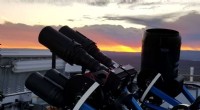
The researchers observed two very distant quasars behind massive galaxy clusters with the DEep Imaging Multi-Object Spectrograph (DEIMOS) on the Keck II Telescope in Hawaii. The enormous gravitational fields of the galaxy clusters bend and magnify light from distant objects behind them, acting like giant lenses that allow astronomers to see fainter, more distant objects.
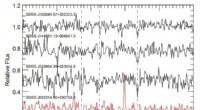
This particular technique, known as strong gravitational lensing, provides natural telescopes that magnify the background quasars, making it possible for astronomers to measure tiny displacements in the quasars' light caused by the expansion of the universe between the two, extremely distant objects.
The magnification due to the gravitational lensing allowed the astronomers to detect light fluctuations that occurred over very short periods of time, enabling them to effectively measure the expansion rate of the universe over only a few tens of millions of years.
"This is currently the most precise measurement of the universe's expansion rate ever made," said Cooke, lead author of the study now at the university of Chicago. "We had to use quasars that are magnified by gravitational lenses to obtain a significant signal."
"Gravitational lenses make it possible to use quasars as rulers to measure the distance between two points in the universe separated by several billion years," Petitjean said. "This cosmic ruler allows us to accurately measure the universe's expansion rate, providing constraints to the most mysterious components of the universe: dark matter and dark energy."
He added that they are lucky there are foreground clusters between the quasars and us, as this gravitational distortion allowed the team to measure the expansion rate over a very early period of the universe.
The team plans to continue making similar observations to provide even more precise measurements of how the expansion rate of the universe has evolved over time. Those observations will help astronomers further constrain models for the evolution of the universe and determine the nature of the mysterious substances that permeate much of the cosmos yet remain undetected by telescopes.