Spitzer Finds Cosmic Oddball
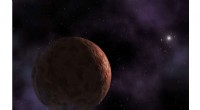
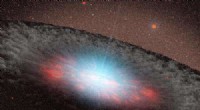
This artist's concept shows four massive planets orbiting a huge brown dwarf star. Brown dwarfs are sometimes called "failed stars" because they are too large to be planets, but not massive enough to sustain nuclear fusion in their cores like full-fledged stars do. NASA's Spitzer Space Telescope has found such a large cosmic oddity in the Milky Way galaxy. Spitzer detected four planets that orbit a large, brown dwarf, named 2MASS J2126-8140. The system, which lies 100 light-years away in the constellation Octans, is the first confirmed case of multiple planets orbiting a brown dwarf.
The four planets are all significantly larger than Earth. They range in mass from 12 to 15 times the mass of our own planet. The planets orbit quite far from their host, 100 to 150 times farther out than Earth does from the Sun. It's unlikely that these planets have liquid water on their surfaces. This means they are unlike Earth in terms of their potential to host life.
Astronomers made their discovery using data collected by Spitzer's infrared array camera, or IRAC. Planets don't shine in visible light like stars do, but they glow in infrared light. The warmer an object is, the brighter is its infrared glow. Spitzer picks up on the heat coming off the planets as they orbit their brown dwarf parent.