The solar wind is a stream of charged particles that constantly flows from the Sun. When these particles reach Earth's magnetic field, they are deflected towards the poles. As they travel along the magnetic field lines, they collide with atoms and molecules in the atmosphere, causing them to glow.
The Cluster mission, which consists of four satellites that orbit Earth in formation, has allowed scientists to study the solar wind and its interaction with Earth's magnetic field in unprecedented detail. The satellites have been able to measure the properties of the solar wind and the magnetic field, and to track the particles as they travel towards the poles.
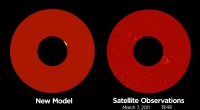
The research team, led by scientists from the Max Planck Institute for Solar System Research in Germany, used data from the Cluster mission to create a detailed computer model of the aurorae. The model showed that the aurorae are formed when the solar wind interacts with the Earth's magnetic field in a specific way.
When the solar wind is strong and steady, it can cause the Earth's magnetic field to become distorted. This distortion creates a region of space around the Earth called the magnetosphere. The magnetosphere is a protective barrier that shields the Earth from the harmful effects of the solar wind.
However, when the solar wind is particularly strong, it can break through the magnetosphere and reach Earth's atmosphere. This is when the aurorae are most likely to occur.
The Cluster mission has provided scientists with a new understanding of how the solar wind interacts with Earth's magnetic field and how this interaction causes the aurorae to shine. The research team hopes that their findings will help to improve our understanding of space weather and its impact on Earth.