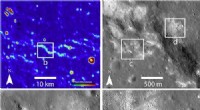
The study, published in the journal Nature Astronomy, examined the surfaces of 10 asteroids using data from the Atacama Large Millimeter/submillimeter Array (ALMA) in Chile. The researchers found that the surfaces of the asteroids were covered in small craters, which suggests that they have been bombarded by meteoroids and other small objects over time.
"We found that the surfaces of these asteroids are much more complex than we thought," said lead author Dr. Vishnu Reddy, a planetary scientist at the University of Arizona. "They are not just smooth, featureless objects, but rather have a rich history of impacts and other geological processes."
The researchers also found that the asteroids' surfaces were not as uniform as they thought. Some areas were covered in more craters than others, suggesting that the asteroids have been subjected to different levels of bombardment over time.
"This study shows that asteroids are not just static objects, but rather dynamic bodies that are constantly changing," said co-author Dr. Francesca DeMeo, a planetary scientist at the Johns Hopkins University Applied Physics Laboratory. "This is important because it helps us to understand the history of the solar system and how it has evolved over time."
The researchers believe that the asteroids' surfaces could be a record of the early solar system, and that by studying them, we can learn more about the conditions that existed at the time.
"Asteroids are like time capsules," said Reddy. "They can tell us about the conditions that existed in the early solar system, and how it has evolved over time. By studying them, we can learn more about our own place in the universe."
The study is the first to use ALMA to study the surfaces of asteroids. ALMA is a powerful telescope that is capable of detecting millimeter-sized objects, which makes it ideal for studying the surfaces of asteroids.
"ALMA is a very powerful telescope, and it has allowed us to see the surfaces of asteroids in unprecedented detail," said Reddy. "This is a major breakthrough, and it is opening up a new era of asteroid exploration."