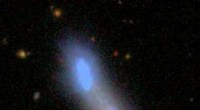
NGC 1132 is an enormous elliptical galaxy approximately 320 million light-years from Earth, located within the Perseus constellation. Its sheer size sets it apart as one of the universe's largest known galaxies, exceeding the Milky Way Galaxy's mass and diameter by several times.
A Fossil of Early Universe's Galaxies
NGC 1132 exhibits unique traits that have captivated the interest of astronomers, leading to the proposal that it might be a "fossil" galaxy dating back to the early universe:
• Old-fashioned Shape: In contrast to the spiral disk structures commonly seen in most galaxies, NGC 1132 has an elliptical shape. These elliptical formations tend to be older, making NGC 1132 a prime candidate for an early universe remnant.
• Red-giant-abundant Core: The presence of a vast amount of red giant stars, which have an older stellar population, characterizes the compact inner regions of NGC 1132. The relative scarcity of younger hot blue stars adds to the notion of an aged system.
Implications:
If astronomers' speculations about NGC 1132 being a cosmological relic prove correct, this galaxy holds pivotal clues to studying and gaining a thorough understanding of how massive ancient galaxies were born within the universe through hierarchical galaxy accretion and merging process in the distant past. Unveiling this evolutionary chapter is one of the central quests of present-day astronomy, delving back more than 13 billion years since the universe. Thus, examining such cosmic artifacts like NGC 1132 will play a substantial role in piecing together the timeline of our cosmos's vast celestial expanse.