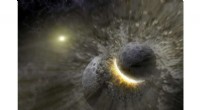
SGRBs are intense bursts of gamma rays that last less than two seconds and are often associated with the merger of neutron stars. They are thought to be the most powerful explosions in the universe, releasing more energy in a fraction of a second than the Sun will emit in its entire lifetime.
SGRBs were first discovered in the late 1970s by the Vela satellites, which were designed to monitor for nuclear explosions in space. However, it was not until the launch of the Compton Gamma-Ray Observatory (CGRO) in 1991 that SGRBs were studied in detail.
The CGRO discovered that SGRBs come in two distinct types: short and long. Short GRBs last less than two seconds, while long GRBs can last for several minutes.
SGRBs are thought to be produced by the merger of neutron stars or the collapse of a rapidly rotating neutron star. When two neutron stars merge, they create a black hole and emit a powerful burst of gamma rays. The collapse of a rapidly rotating neutron star can also produce a GRB.
SGRBs are rare events, and only a handful have been observed in detail. However, they are thought to be a significant source of heavy elements in the universe.