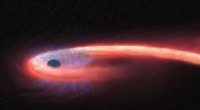
The Herschel space observatory, a joint project of the European Space Agency (ESA) and NASA, has captured stunning images of the birth of stars in the Orion Nebula. The Orion Nebula is a vast, glowing cloud of gas and dust located about 1,350 light-years away from Earth. It is one of the most active star-forming regions in our galaxy, and is home to several young, hot stars.
Using its infrared telescope, Herschel was able to peer through the thick dust and gas of the Orion Nebula and observe the young stars as they formed. The images reveal a chaotic and dynamic environment, with jets of gas and dust being ejected from the young stars and colliding with the surrounding material. These jets are thought to be a key part of the star-formation process, helping to shape the stars and clear away the surrounding material.
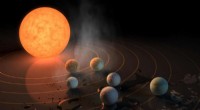
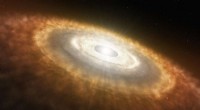
The Herschel images also show evidence of protoplanetary disks, which are the dusty disks of material that surround young stars and from which planets can eventually form. These disks are seen as faint rings of dust surrounding the young stars.
The Herschel observations provide a unique glimpse into the earliest stages of star formation, and help scientists to better understand how stars and planets form.
Image Credit: ESA/Herschel/PACS/SPIRE Consortium