1. Transit Photometry:
- This method involves observing a star's brightness over time to detect slight dips in brightness caused by a planet passing in front of the star (a transit).
- These dips indicate the planet's size relative to the star.
- The Transiting Exoplanet Survey Satellite (TESS) is a space telescope dedicated to finding exoplanets using this method.
2. Radial Velocity:
- Radial velocity, also known as the Doppler method, measures the slight wobbles in a star's motion caused by the gravitational pull of a planet orbiting it.
- These wobbles change the wavelength of the star's light, allowing astronomers to infer the presence and characteristics of the orbiting planet.
- This technique has led to the discovery of numerous exoplanets.
3. Direct Imaging:
- Direct imaging involves taking high-resolution images of stars to directly observe exoplanets.
- This is challenging due to the vast distance and small size of exoplanets compared to their host stars.
- Recent advances in telescope technology and adaptive optics have made this method more feasible.
4. Microlensing:
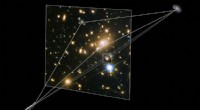
- Gravitational microlensing occurs when the gravitational field of a foreground star bends the light of a more distant star behind it, causing a temporary brightening of the background star.
- If a planet is orbiting the foreground star, it can cause additional brightening or distortion, allowing astronomers to detect its presence.
5. Pulsar Timing:
- Pulsars are rapidly rotating neutron stars that emit regular pulses of radio waves.
- Planets orbiting pulsars can cause irregularities in the timing of these pulses, which can be detected and used to infer the presence of exoplanets.
6. Transit Spectroscopy:
- When an exoplanet transits in front of its host star, astronomers can use spectroscopy to analyze the star's light that passes through the planet's atmosphere.
- This allows them to study the composition and properties of the exoplanet's atmosphere, such as the presence of molecules like water, methane, or carbon dioxide.
7. Astrometry:
- Astrometry involves measuring the precise positions of stars over time.
- If a star has an orbiting planet, its position may change slightly due to the gravitational influence of the planet.
- This can be detected by comparing high-precision astrometric measurements over long periods.
It's important to note that hunting for and confirming exoplanets involves extensive observations, analysis of data, and often follow-up observations to refine the understanding of the properties of the discovered exoplanets.