Massive stars are born in giant molecular clouds, which are cold clouds of gas and dust. As a massive star forms, it emits a powerful wind of particles that can blow away the surrounding gas and dust. This process is called photoevaporation.
Photoevaporation is thought to be the main reason why massive stars are often found in isolation, rather than in clusters. However, some massive stars are found in clusters, and it is not clear why these stars have not blown away their natal gas clouds.
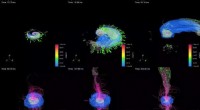
New simulations by a team of astronomers led by John Bally of the University of Colorado at Boulder suggest that these stars use their powerful radiation to heat the gas, causing it to expand and disperse. The simulations show that this process can prevent photoevaporation from blowing away the gas clouds.
The simulations also show that the amount of time it takes for a massive star to blow away its natal gas cloud depends on the mass of the star and the density of the gas cloud. For a star with a mass of 10 solar masses, it can take up to 20 million years to blow away a gas cloud with a density of 1,000 particles per cubic centimeter.
These simulations provide new insights into the formation of massive stars and help to explain why some massive stars are found in clusters.
The simulations were published in the journal Monthly Notices of the Royal Astronomical Society.