The James Webb Space Telescope (JWST) is the most ambitious and expensive space telescope ever built. It is designed to study the universe in infrared light, which will allow it to see objects that are too faint or too distant to be seen by visible-light telescopes.
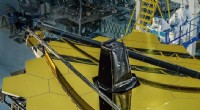
The JWST is also equipped with a massive sunshield that will protect it from the Sun's heat. The sunshield is made of five layers of a thin, reflective material called Kapton. Each layer is about the size of a tennis court, and the entire sunshield is about the size of a football field.
The sunshield is designed to block out almost all of the Sun's light and heat, which will keep the JWST's instruments cold enough to operate properly. The instruments are so sensitive that they need to be kept at a temperature of about -233 degrees Celsius (-387 degrees Fahrenheit).
Testing the Sunshield
Before the JWST is launched into space, it is being thoroughly tested to make sure that it will work properly. One of the most important tests is the sunshield test.
The sunshield test is being conducted at the Johnson Space Center in Houston, Texas. The test facility is a giant vacuum chamber that can simulate the conditions of space. The JWST is placed inside the vacuum chamber, and the sunshield is deployed. Then, a powerful light source is used to simulate the Sun's heat.
The sunshield test is designed to measure how well the sunshield blocks out the Sun's light and heat. The results of the test so far have been very positive. The sunshield is performing even better than expected, and it is expected to keep the JWST's instruments cold enough to operate properly.
The Importance of the Sunshield
The sunshield is a critical part of the JWST. Without the sunshield, the JWST would not be able to operate properly. The sunshield is what will allow the JWST to see the universe in infrared light and make groundbreaking discoveries about the early universe.
The JWST is scheduled to be launched into space in 2021. It will take about six months for the JWST to reach its destination, which is a point in space about 1.5 million kilometers (1 million miles) from Earth. Once the JWST is in place, it will begin its mission to study the universe in infrared light.