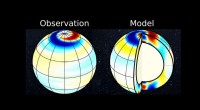
Over time, the core has cooled down, but it is still very hot. The temperature at the center of the core is estimated to be about 5,700 degrees Celsius, which is hotter than the surface of the Sun. The pressure at the center of the core is also very high, about 3.6 million times the pressure at sea level.
The Earth's core is constantly in motion. The molten iron and nickel in the core convect, meaning that they rise and fall in convective currents. This convection process generates the Earth's magnetic field. The magnetic field protects the Earth from harmful solar radiation, and it also helps animals such as birds and insects to navigate.
The Earth's core is also responsible for the planet's rotation. The convection process in the core creates a force called the Coriolis force. The Coriolis force causes the Earth to rotate on its axis.
The Earth's core is an important part of the planet. It keeps the Earth's magnetic field in operation, and it helps to regulate the Earth's rotation. Without the core, the Earth would be a very different planet.