1. Triggering Gravitational Collapse:
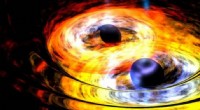
In some cases, the gravitational force exerted by a black hole on the nearby interstellar gas can initiate the process of gravitational collapse. Gas clouds in the vicinity of a black hole can become gravitationally bound and condense under the influence of the black hole's strong gravitational field. This gravitational collapse can lead to the formation of dense clumps of gas, which can eventually form new stars.
2. Compressing Gas and Triggering Starbursts:
The presence of a black hole can contribute to the compression of surrounding gas and dust, leading to an increase in the density of the interstellar medium. This compression can induce the formation of large-scale star-forming regions, triggering episodes of intense star formation known as "starbursts."
3. Disrupting Gas Flows and Fragmentation:
The gravitational influence of a black hole can disrupt the regular flow of gas in the surrounding area, leading to the formation of turbulent and fragmented structures in the gas distribution. This fragmentation can create favorable conditions for the formation of individual stars or star clusters.
4. Channeling Inflowing Material:
Black holes can act as channels for inflows of gas and dust towards the central regions. This channeled material can accumulate and contribute to the growth of stellar clusters around the black hole.
It's important to note that the exact effects of a black hole on star formation depend on various factors, including the mass of the black hole, its distance from the star-forming region, and the characteristics of the surrounding gas and dust. In some cases, the presence of a black hole can inhibit star formation by disrupting the necessary conditions, while in other cases, it can enhance star formation by triggering gravitational collapse and providing a dense environment for star birth.