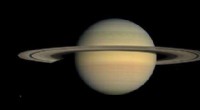
This new understanding of Saturn's jet streams is supported by Cassini's observations of the planet's clouds, which are composed of ammonia ice particles. The clouds are seen to be moving at different speeds, and the boundaries between the different cloud layers correspond to the locations of the vortices.
The vortices are thought to be caused by the interaction of the planet's rotation and the solar heat that is absorbed by the atmosphere. The heat creates convection currents, which rise and fall in the atmosphere, carrying clouds with them. The vortices form where the convection currents are strongest.
The vortices are important for understanding the climate of Saturn. They help to distribute heat around the planet, and they also affect the planet's wind patterns. The vortices also play a role in the formation of Saturn's hexagonal-shaped north polar vortex.
Cassini's observations of Saturn's jet streams are helping scientists to better understand the weather of this giant planet. By understanding how the jet streams work, scientists can better understand how Saturn's climate changes over time.