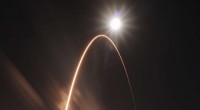
As ISON got closer to the Sun, its icy structure, composed mostly of frozen water, carbon dioxide, and methane, began to rapidly heat up. This caused the comet to release gas and dust, creating a bright tail that could be seen from Earth with binoculars or small telescopes.
However, the immense heat and radiation from the Sun overpowered the comet's structure. Scientists and observers watching the comet closely noticed a dimming in its brightness and a change in its appearance as it approached perihelion. Instead of surviving the close encounter and emerging intact, ISON broke apart into several pieces due to the intense solar radiation and tidal forces.
Instead of surviving its near brush with the sun and continuing on its journey, comet C/2012 S1 (ISON) fragmented and disintegrated under the extreme conditions near the Sun. This fate is not uncommon for comets that venture too close to the Sun.