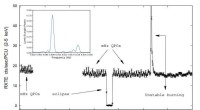
The potential exomoon is located around a gas giant planet called Kepler-1625b, which is about the size of Jupiter and orbits a star roughly 4,000 light-years away in the constellation Cygnus.
The discovery was made using a technique called astrometry, which measures the precise position of stars over time. Kepler-1625b causes its host star to "wobble" slightly as it orbits, and the presence of an exomoon would cause the star to wobble even more. By measuring the star's motion, astronomers were able to infer the presence of a possible exomoon.
However, the researchers involved caution that there could be other explanations for the wobble, such as another giant planet or a group of smaller objects orbiting Kepler-1625b. Further observations and analysis will be needed to confirm the existence of the exomoon and to determine its properties.
If confirmed, the discovery of an exomoon would provide valuable insights into the formation and evolution of planetary systems. It would also raise questions about the potential habitability of exomoons, as some exomoons could potentially have the right conditions to support liquid water on their surfaces.
Here are some additional details about the potential exomoon:
Name: The researchers propose the name "Kepler-1625b I" for the potential exomoon.
Mass: The estimated mass of Kepler-1625b I is about 1 to 3 times the mass of the Earth.
Orbit: Kepler-1625b I orbits Kepler-1625b about every 28 days.
Distance: The average distance between Kepler-1625b I and Kepler-1625b is about 7.1 million kilometers (4.4 million miles).
Temperature: The estimated surface temperature of Kepler-1625b I is around -226 degrees Celsius (-375 degrees Fahrenheit).
Atmosphere: The presence or composition of an atmosphere on Kepler-1625b I is unknown.
Overall, the detection of a potential exomoon is an exciting development in the study of exoplanets and could pave the way for future discoveries of more moons beyond our solar system.