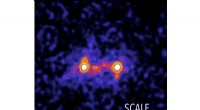
- Dark matter: The existence of the Higgs boson constrains theories of dark matter, as it can affect the interactions and properties of dark matter particles. Some models suggest that the Higgs boson could be involved in the production or decay of dark matter particles. By better understanding the Higgs boson, scientists can refine their models of dark matter and potentially detect its elusive nature.
- Quark-Gluon Plasma (QGP): The conditions achieved in high-energy particle collisions at CERN, such as those involving heavy ions, create a state of matter called Quark-Gluon Plasma (QGP), which existed during the early moments of the universe. Studying the properties of QGP at CERN provides valuable information about the fundamental forces governing matter under extreme conditions. This knowledge can help astrophysicists understand phenomena like neutron star mergers, the early evolution of the universe, and the physics of compact objects.
- Neutrinos: CERN experiments have contributed to the study of neutrino properties and oscillations, which are crucial in understanding the evolution and composition of the universe. Neutrinos are subatomic particles that play essential roles in various astrophysical processes, such as supernovae and the cosmic neutrino background. By precisely measuring neutrino properties at CERN, scientists gain insights into their behavior in extreme environments and their role in shaping the large-scale structure of the cosmos.
- Beyond the Standard Model: The discovery of the Higgs boson and other exotic particles at CERN also points towards the need for physics beyond the Standard Model of particle physics. Theories that extend beyond the Standard Model, such as supersymmetry, predict the existence of additional particles and forces that could have significant astrophysical implications. For instance, supersymmetric particles could account for the observed properties of dark matter, provide explanations for cosmic ray anomalies, or participate in the processes that generate the high energies observed in astrophysical phenomena like active galactic nuclei and gamma-ray bursts.
By pushing the boundaries of our knowledge about subatomic particles, CERN's discoveries open up new avenues for exploring the mysteries of the universe. Collaborative efforts between particle physicists and astrophysicists are essential in interpreting CERN's findings and advancing our understanding of the cosmos.