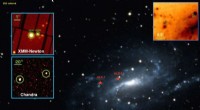
XMM-Newton is a European Space Agency (ESA) X-ray observatory that was launched in 1999. It is one of the most powerful X-ray telescopes ever built, and it has been used to study a wide variety of objects in the universe, including stars, galaxies, and black holes.
In a recent study, a team of astronomers used XMM-Newton to observe a pair-instability supernova that occurred in a galaxy about 12 billion light-years from Earth. This is the most distant pair-instability supernova ever observed, and it provides new insights into how these explosions occur.
The astronomers found that the pair-instability supernova was triggered by the collapse of a massive star that was about 100 times more massive than the Sun. When the star collapsed, it created a shock wave that traveled through the star and heated it to extremely high temperatures. This caused the star to produce pairs of electrons and positrons, which are particles that have opposite charges.
The electrons and positrons annihilated each other, releasing enormous amounts of energy. This energy drove the pair-instability supernova, which ejected a large amount of material into space. The astronomers estimate that the supernova ejected about 10 solar masses of material, which is equivalent to about 10% of the mass of the Sun.
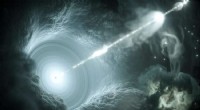
The pair-instability supernova also produced a powerful X-ray blast. This blast was detected by XMM-Newton, and it allowed the astronomers to study the supernova in detail. The X-ray data showed that the supernova was extremely hot, and that it produced a large amount of heavy elements.
The astronomers believe that pair-instability supernovae played a key role in the early universe. These explosions are thought to have produced the first heavy elements, which are essential for the formation of stars and galaxies. Pair-instability supernovae may also have helped to reheat the early universe, which allowed it to expand and cool more evenly.
The observations of the pair-instability supernova by XMM-Newton provide new insights into how these explosions occur. These observations also help to shed light on the early universe, and how it evolved into the universe we see today.