1. Visible Light:
- Visible light is the portion of the electromagnetic spectrum that our eyes can detect. Observing the Sun in visible light provides basic information about its surface features, such as sunspots, granulation, and flares.
2. Ultraviolet (UV) Light:
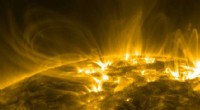
- UV light has shorter wavelengths than visible light and can provide information about the Sun's outer atmosphere, known as the chromosphere and the corona. UV observations help study solar activity, including prominences, coronal loops, and the behavior of the solar wind.
3. X-rays:
- X-rays are high-energy electromagnetic radiation emitted by extremely hot gases in the Sun's atmosphere. X-ray observations reveal information about the Sun's corona, solar flares, and coronal mass ejections (CMEs).
4. Infrared (IR) Light:
- IR light has longer wavelengths than visible light and can penetrate deeper into the Sun's interior. IR observations provide information about the Sun's radiative processes, temperature variations, and the dynamics of the photosphere.
5. Radio Waves:
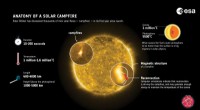
- Radio waves are the longest wavelengths of the electromagnetic spectrum and can be used to study the Sun's magnetic fields, particle acceleration, and coronal activity. Radio telescopes help monitor solar storms and space weather events.
6. Gamma Rays:
- Gamma rays are the highest-energy photons emitted during extreme solar events, such as solar flares and particle interactions. Gamma-ray observations provide insights into the Sun's energetic phenomena and their potential impact on Earth's magnetosphere and atmosphere.
By combining observations from different wavelengths, scientists can create a complete picture of the Sun's dynamic behavior, including its magnetic activity, energy release, and its impact on Earth and the heliosphere. This knowledge is crucial for understanding space weather, predicting solar storms, and ensuring the safety of astronauts and satellites in space.