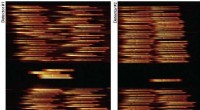
1. Transit Spectroscopy: When an exoplanet passes in front of its host star (a transit), a small fraction of the star's light passes through the exoplanet's atmosphere. This allows astronomers to analyze the absorption or emission features in the starlight, revealing information about the composition and temperature of the exoplanet's atmosphere.
2. Secondary Eclipse Spectroscopy: During a secondary eclipse, the exoplanet passes behind its host star. As the exoplanet blocks some of the star's light, astronomers can study the thermal emission from the exoplanet's dayside atmosphere, providing insights into its composition and temperature.
3. Radial Velocity Method: By precisely measuring the slight wobbles in a star's motion caused by the gravitational pull of an orbiting exoplanet, astronomers can indirectly infer the presence of the exoplanet. This method can also provide information about the mass and composition of the exoplanet's atmosphere through spectroscopic observations of the host star.
4. Direct Imaging and Spectroscopy: In some cases, astronomers can directly image exoplanets using high-resolution telescopes and advanced imaging techniques. This enables the study of the exoplanet's surface features and atmospheric properties through spectroscopy.
5. Atmospheric Escape and Absorption: By observing the absorption of specific gases in the exoplanet's atmosphere, astronomers can infer information about the escape of atmospheric gases into space. Additionally, the presence of certain gases can indicate ongoing geological or biological activity on the exoplanet.
6. Polarization and Phase Curves: By studying the polarization of light reflected from an exoplanet's atmosphere and its phase curve (changes in brightness as viewed from different angles), astronomers can gain insights into the composition, cloud structure, and scattering properties of the atmosphere.
The effectiveness of these methods depends on the characteristics of the exoplanet and its host star. Larger exoplanets with substantial atmospheres are easier to study compared to smaller ones with thin atmospheres. Additionally, the distance to the exoplanetary system and the brightness of the host star influence the quality and quantity of data that can be collected.
As technology continues to advance, astronomers are developing new and more sensitive techniques to study exoplanet atmospheres, pushing the boundaries of our knowledge about these distant worlds and their potential for habitability.