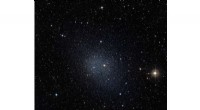
1. Tidal Disruption: If a galactic dwarf passes too close to a supermassive black hole, the immense gravitational forces can cause the dwarf galaxy to be tidally disrupted. This means that the dwarf galaxy's stars, gas, and other components are ripped apart and scattered, contributing to the surrounding material of the black hole.
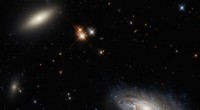
2. Merging and Absorption: In some cases, a galactic dwarf can merge with a larger galaxy, such as an elliptical galaxy. When the dwarf enters the gravitational influence of the larger galaxy, it may lose its structural integrity and eventually become absorbed or cannibalized by the more massive system. The dwarf galaxy's stars and material become part of the larger galaxy, contributing to its overall mass and structure.
3. Star Formation Triggering: The interaction between a cosmic giant and a galactic dwarf can also trigger bursts of star formation in the dwarf galaxy. The gravitational influence of the larger system can compress and disturb the gas and dust in the dwarf galaxy, leading to the formation of new stars. This process is often referred to as "tidal triggering" or "ram pressure stripping," where the gravitational interaction between the two systems enhances the star formation activity in the dwarf galaxy.
4. Galaxy Harassment: Repeated encounters between a cosmic giant and a galactic dwarf can lead to a process called "galaxy harassment." This refers to the gradual stripping and transformation of the dwarf galaxy due to the gravitational interactions. Over time, the dwarf galaxy's structure can be disrupted, its stars and material can be scattered or redistributed, and its overall properties can be altered as a result of these encounters.
5. Gravitational Influence and Orbiting: In certain cases, a galactic dwarf may not merge with or be completely disrupted by a cosmic giant. Instead, it can enter an orbit around the larger system. The gravitational influence of the cosmic giant can affect the dwarf galaxy's orbit, shape, and dynamics, leading to changes in its structure and properties over time.
The outcomes of interactions between cosmic giants and galactic dwarfs depend on various factors, including the relative masses and sizes of the systems, their initial conditions, and the specific dynamics of the encounter. These interactions can play important roles in shaping the evolution and properties of galaxies in the universe.