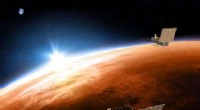
For centuries, scientists and astronomers have been captivated by the mystery surrounding the origins of Mars' two moons, Phobos and Deimos. Unlike Earth's moon, which is a natural satellite formed through a unique set of circumstances, the moons of Mars have intrigued scientists due to their peculiar characteristics and the prevailing theories about their formation. Among these theories, the giant impact hypothesis stands out as the leading explanation for the genesis of Phobos and Deimos.
The Giant Impact Theory
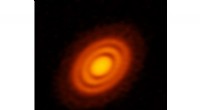
According to the giant impact theory, a celestial body of significant size, possibly comparable to the planet Mercury, collided with Mars billions of years ago. This cataclysmic event is believed to have ejected a substantial amount of Martian material into orbit around the planet, forming a debris disk. Within this disk, Phobos and Deimos gradually coalesced from the accumulating debris, eventually becoming the moons we observe today.
Evidence Supporting the Theory
Several lines of evidence support the giant impact theory as the most plausible explanation for the formation of Mars' moons:
1. Composition and Similarity: Both Phobos and Deimos are composed primarily of rocks similar in composition to the surface materials of Mars, suggesting a common origin.
2. Orbits and Shapes: The orbits of Phobos and Deimos are relatively close to Mars, and their shapes are irregular, resembling captured asteroids rather than bodies formed directly from the protoplanetary disk that created Mars.
3. Tidal Locking: Phobos and Deimos are tidally locked to Mars, meaning one side of each moon always faces the planet, similar to Pluto's moon Charon. This tidal locking is consistent with a scenario where the moons formed from a debris disk close to Mars.
Challenges and Alternative Theories
While the giant impact theory remains the leading explanation, some challenges and alternative theories have also been proposed:
1. Lack of Direct Evidence: The theory relies on indirect evidence and simulations, as there is no direct observational evidence of the impact event or the subsequent formation of the moons.
2. Orbital Evolution: The giant impact theory requires specific conditions and orbital evolution scenarios to explain the current orbits of Phobos and Deimos. Some studies suggest that the moons may have migrated inward or been perturbed by external factors over time.
3. Alternative Formation Mechanisms: Some researchers have proposed alternative formation mechanisms, such as the capture of asteroids or the formation of the moons from Mars' once-extensive atmosphere.
Despite these challenges, the giant impact theory continues to be the most widely accepted explanation for the origin of Mars' moons. It provides a plausible explanation for their composition, orbits, and tidal locking, and is consistent with our current understanding of planetary formation and evolution. Future missions and observations aimed at studying the geology, composition, and history of Phobos and Deimos may further refine and validate this theory or provide new insights into the enigmatic formation of these Martian moons.