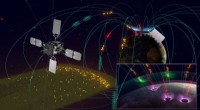
1. Solar Wind Erosion: MAVEN discovered that the solar wind-Mars interaction plays a significant role in atmospheric escape. The solar wind, a stream of charged particles from the Sun, directly strips away ions from the upper layers of the Martian atmosphere. This process, known as ion escape, is enhanced during solar storms and when Mars is in certain regions of its orbit around the sun.
2. Atmospheric Stripping by Solar Energetic Particles: MAVEN also found that solar energetic particles (SEPs), which are energetic particles emitted during solar flares and coronal mass ejections, can cause significant atmospheric erosion. SEPs interact with the Martian atmosphere, ionizing atoms and molecules, which can then be swept away by the solar wind.
3. Jeans Escape: MAVEN observations revealed that Jeans escape is another mechanism contributing to atmospheric loss. Jeans escape occurs when atoms or molecules in the thermosphere( the hottest part of the atmosphere) have enough thermal energy to overcome Mars' gravity and escape into space. This process is particularly efficient for hydrogen and helium, the lightest elements in the atmosphere.
4. Influence of Crustal Magnetic Fields: MAVEN discovered that areas with strong crustal magnetic fields on Mars experience reduced atmospheric loss. Crustal magnetic fields create an obstacle to the solar wind, shielding the atmosphere from direct impact and reducing the rate of atmospheric erosion.
5. Escape Estimates and Past Atmospheric Density: MAVEN's observations allowed researchers to estimate the total amount of atmospheric gas loss over time. The mission's data suggests that Mars might have lost about 66% of its carbon dioxide(CO2) inventory, 95% of the water (H20) inventory, and much of its other volatile compounds. These estimates provide insights into the early, dense atmosphere of Mars and the possible presence of liquid water in the past.
6. Ancient Water Loss: MAVEN's investigation into atmospheric loss also has implications for understanding the water history of Mars. The mission's findings indicate that early in Mars' history, around 4 billion years ago, the planet may have lost water equivalent to a global ocean nearly 300 meters deep. This ancient water loss contributes to the current arid conditions on Mars.
MAVEN's findings have advanced scientific understanding of the Martian atmosphere and its evolution over time. By identifying the key processes responsible for the loss of the atmosphere to space, MAVEN has provided crucial information for piecing together the history of the Red Planet and its transition from a potentially habitable environment to the cold and arid world we observe today.