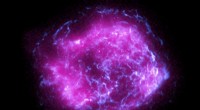
Wolf-Rayet stars are typically found in young star clusters and associations, and are thought to be in a late stage of their evolution, just prior to becoming supernovae. They are extremely massive, with masses ranging from 10 to 100 times that of our Sun, and they have very high surface temperatures, ranging from 25,000 to 250,000 degrees Celsius.
One of the key characteristics of Wolf-Rayet stars is their strong stellar winds, which can reach speeds of up to several thousand kilometers per second. These winds are driven by the star's intense radiation pressure and can lead to the star losing a significant amount of mass. As a result, Wolf-Rayet stars often appear as luminous bubbles of gas and plasma, known as Wolf-Rayet nebulae.
Wolf-Rayet stars are also known for their unusual spectral features, which include strong emission lines of helium, nitrogen, and oxygen. These emission lines are caused by the intense ionization of the gases in the star's atmosphere and can provide valuable insights into the star's physical properties and evolutionary stage.
Wolf-Rayet stars are relatively rare, but they play an important role in the evolution of galaxies and the enrichment of the interstellar medium. They are thought to be the progenitors of some types of supernovae and are believed to contribute significant amounts of heavy elements to the surrounding environment through their stellar winds and explosions.