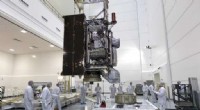
GRACE-FO follows on from the successful GRACE mission, which operated from 2002 to 2017 and provided valuable insights into Earth's water cycle and changes in ice sheets and glaciers. The new mission features improved instrumentation and technology, allowing for even more precise measurements.
Here's how GRACE-FO works to weigh water on Earth:
1. Satellite Configuration: GRACE-FO consists of two identical satellites flying in formation, about 220 kilometers apart. One satellite follows the other in the same orbit, which is inclined at 89 degrees to the equator.
2. Microwave Ranging System: Each satellite is equipped with a microwave ranging system that continuously measures the distance between the two satellites with extreme accuracy. This is achieved using a Ka-band microwave link that operates at a frequency of 32 GHz.
3. Gravitational Perturbations: As the satellites orbit Earth, they experience slight changes in their velocity due to variations in the gravitational field. These changes are caused by the uneven distribution of mass on Earth, including changes in the amount of water stored in lakes, rivers, groundwater reservoirs, glaciers, and ice sheets.
4. Data Processing: The microwave ranging data collected by the satellites is processed on the ground to determine the precise distance between them. Changes in this distance over time are used to calculate changes in Earth's gravity field.
5. Water Mass Estimation: By combining the gravity field data with other observations, such as surface elevation measurements from radar altimetry, scientists can estimate changes in water mass on Earth. They can determine how much water is stored in different regions, monitor the movement of water between different reservoirs, and track changes in ice sheet and glacier mass.
6. Global Coverage: GRACE-FO provides global coverage, allowing scientists to study water-related changes in various parts of the world. The mission's data helps improve our understanding of the global water cycle, climate variability, sea-level rise, and how human activities impact water resources.
The precise measurements from GRACE-FO are crucial for monitoring Earth's water resources and studying the impact of climate change on the planet's water systems. The mission provides valuable data for researchers, policymakers, and water managers to make informed decisions related to water conservation, flood management, drought mitigation, and sustainable water use.