Black holes, known for their immense gravitational pull, have long captivated the scientific community. While it is commonly believed that nothing, not even light, can escape a black hole's gravitational clutches, recent simulations have revealed a fascinating phenomenon that could potentially offer a way to escape—powerful plasma jets.
In this article, we delve into the groundbreaking simulations conducted by astrophysicists, which provide new clues about these enigmatic plasma jets and offer hope for unraveling the mysteries of black hole physics.
Magnetic Field Lines as Key Players:
At the heart of these simulations lies the concept of magnetic field lines. Black holes are known to possess strong magnetic fields, which become even more intense near the event horizon, the boundary beyond which nothing is believed to escape.
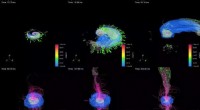
The simulations demonstrate that these intense magnetic field lines can act as channels for matter to escape from the black hole's gravitational grip. As matter falls towards the black hole, it becomes highly energized and forms a swirling disk of plasma around the black hole, known as an accretion disk.
Accretion Disk and Plasma Jet Formation:
Within the accretion disk, the intense magnetic fields twist and tangle, creating a dynamo effect that generates even stronger magnetic fields. These powerful magnetic fields then extract energy from the rotating accretion disk, launching jets of plasma into the surrounding space.
The plasma jets are highly collimated, meaning they are focused into narrow beams that can extend far beyond the event horizon. The simulations reveal that these jets are driven by the interplay between the intense magnetic fields and the rotating plasma in the accretion disk.
Speed and Energy of Plasma Jets:
The simulations also shed light on the incredible speed and energy of these plasma jets. The plasma is accelerated to speeds close to the speed of light, and the jets carry enormous amounts of energy, allowing them to propagate over vast distances.
The energy carried by these jets could potentially be harnessed for various astrophysical phenomena, including the formation of stars and galaxies. Further research is necessary to fully understand the implications of these powerful outflows.
Observational Evidence:
While these simulations provide compelling evidence for the existence of plasma jets near black holes, observational evidence remains limited. However, there have been some promising observations of jet-like structures in the vicinity of black holes, supporting the theoretical predictions.
Continual advancements in observational techniques, such as high-resolution imaging and spectroscopy, are expected to enable more detailed observations of plasma jets in the future, helping to validate the simulation results and deepen our understanding of black hole physics.
In conclusion, these groundbreaking simulations offer a glimpse into the possibility of escaping the gravitational clutches of black holes through powerful plasma jets. By unraveling the mechanisms behind these jets and studying their properties, we gain new insights into the extreme physics occurring near black holes and advance our understanding of the cosmos.