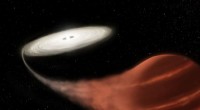
One way astronomers have been able to image black holes is by observing the effects they have on the surrounding space. When a black hole is actively accreting matter from a nearby star or gas cloud, it can emit jets of high-energy particles. These jets are often visible in radio and X-ray wavelengths, and astronomers can use these observations to infer the presence of a black hole.
Another way astronomers have been able to image black holes is by using gravitational lensing. This occurs when the gravitational field of a massive object, such as a black hole, warps the light from nearby stars. By observing these distortions, astronomers can reconstruct an image of the black hole.
In 2019, the Event Horizon Telescope (EHT) collaboration released the first direct image of a black hole. The image was of the supermassive black hole at the center of the galaxy M87. The EHT is a network of radio telescopes that were specially designed to observe black holes. By combining the data from all of the telescopes, astronomers were able to produce an image that shows the black hole's event horizon. The event horizon is the boundary beyond which nothing, not even light, can escape from a black hole.
Black holes are one of the most mysterious objects in the universe, and astronomers are constantly learning new things about them. The images that astronomers have been able to capture provide a glimpse into these fascinating objects and help us to better understand their properties.