The perception of time is a complex cognitive process that is influenced by a variety of factors, including our environment, our state of mind, and our culture. In particular, the way we perceive time can be affected by our physical location in space. This is because the gravitational field of the Earth warps spacetime, which can lead to subtle changes in the rate at which time passes.
Research
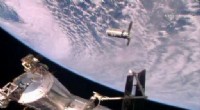
A number of studies have investigated the effects of space travel on the perception of time. One study, conducted by astronauts on the International Space Station, found that the astronauts experienced a slight slowing down of time. This was due to the fact that the astronauts were in a lower gravitational field than they were on Earth.
Another study, conducted by scientists at the University of Tokyo, found that astronauts who were exposed to high levels of radiation experienced a speeding up of time. This was because the radiation damaged the astronauts' DNA, which caused their cells to age more quickly.
Implications
The findings of these studies suggest that the perception of time is not a fixed and immutable property, but rather something that can be influenced by our physical environment. This has implications for our understanding of the nature of time and for the development of future space missions.
Conclusion
The study of how time is perceived in space is a challenging and complex field, but it is also one that is full of potential rewards. By understanding how the perception of time is affected by gravity and radiation, we can gain new insights into the nature of time and the human experience.