1. Differential Rotation:
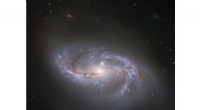
Stars within the Milky Way do not all orbit the galactic center at the same speed. Stars closer to the center have a higher orbital velocity compared to those farther out. This difference in rotational speeds leads to a "winding up" effect, causing stars to form spiral arms as they move in their orbits.
2. Density Waves:
Density waves are self-propagating patterns that develop within the galactic disc due to gravitational interactions between stars and gas. These waves cause local enhancements in star formation and gas density, leading to the formation of spiral arms.
3. Galactic Bar:
At the center of the Milky Way is a prominent elongated structure called the galactic bar. The bar is made up of stars and gas and rotates differentially. It is believed that the bar plays a crucial role in driving the formation and maintenance of the galaxy's spiral arms.
4. Interactions and Mergers:
The Milky Way has likely experienced interactions and mergers with other smaller galaxies in the past. These encounters can trigger and enhance spiral arm formation, as the infalling galaxies can disturb the disc dynamics and induce density waves.
5. Gas and Star Formation:
The spiral arms are typically regions of active star formation. As gas accumulates in the spiral arms, it becomes compressed and denser, leading to the formation of new stars. The young, bright stars, along with the presence of gas and dust, give the spiral arms their characteristic appearance.
6. Dark Matter:
Dark matter, a mysterious and non-luminous form of matter, plays a crucial role in shaping the structure of galaxies, including their spiral forms. Dark matter's gravitational influence helps stabilize and maintain the spiral patterns by providing additional mass and counteracting the centrifugal forces that would otherwise disrupt the galaxy.
It's important to note that the formation and evolution of spiral galaxies are complex processes that are still not fully understood, and ongoing research continues to shed more light on the mechanisms behind the spiral structure of the Milky Way and other galaxies.